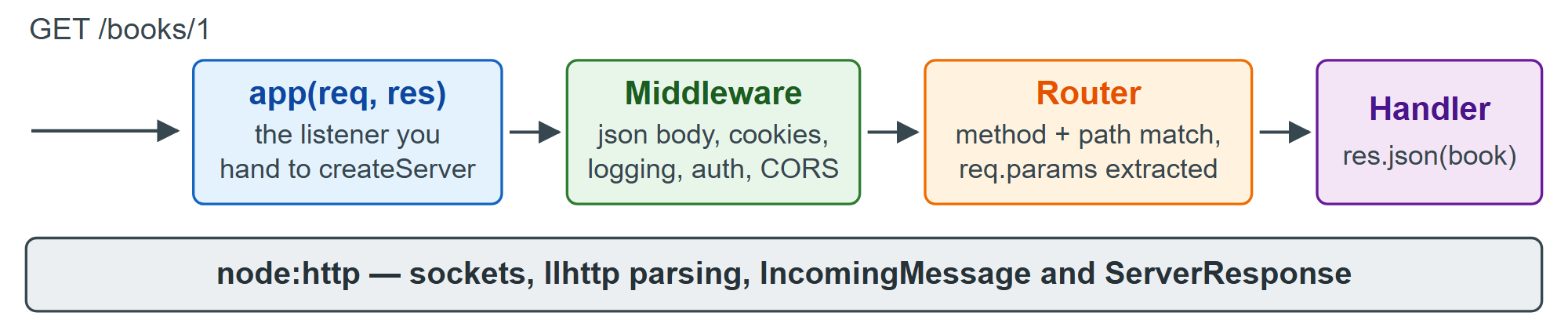
An Express 24,430 application is a listener function. const app = express() returns a function of (req, res) you could hand to http.createServer yourself, and app.listen() is the convenience that does it. The sockets, the llhttp parser and the IncomingMessage/ServerResponse objects of An HTTP Server by Hand are unchanged; Express decorates those objects and inserts a dispatcher in front of your code.
This is the Express equivalent of the hand-written endpoint in An HTTP Server by Hand, plus a second route. No URL construction, no method comparison, no writeHead with a hand-computed Content-Length, no body chunks.
import express from 'express';
const app = express();
app.use(express.json());
const books = [{ id: 1, title: 'Node in Practice', authorId: 7 }];
app.get('/books/:id', (req, res) => {
  const book = books.find((b) => b.id === Number(req.params.id));
  book ? res.json(book) : res.status(404).json({ error: 'not found' });
});
app.post('/books', (req, res) => {
  const book = { id: books.length + 1, ...req.body };
  books.push(book);
  res.status(201).location(`/books/${book.id}`).json(book);
});
app.listen(3000, () => console.log('listening on http://localhost:3000'));
A curl 3,008 -i -X POST localhost:3000/books with a JSON -d body and a content-type header returns:
HTTP/1.1 201 Created
X-Powered-By: Express
Location: /books/2
Content-Type: application/json; charset=utf-8
Content-Length: 49
ETag: W/"31-PpkM77O+WL8dmUJcxpE3ZT5qLe8"
{"id":2,"title":"Express in Action","authorId":3}
Four of those headers you never wrote. res.json serialized the object, set Content-Type with the charset, computed Content-Length from the UTF-8 byte length, and hashed the body into a weak ETag so a repeat request carrying If-None-Match can be answered with 304 (ETags and Conditional Requests). res.status and res.location are chainable setters. On the request side req.params.id came from the :id segment, and req.body came from express.json(), which drained the stream, enforced a 100 kB default limit and rejected malformed JSON with a 400 before your handler ran. Remove X-Powered-By, which advertises your framework for no benefit, with app.disable('x-powered-by') or Helmet 10,736 (Security Headers with Helmet).