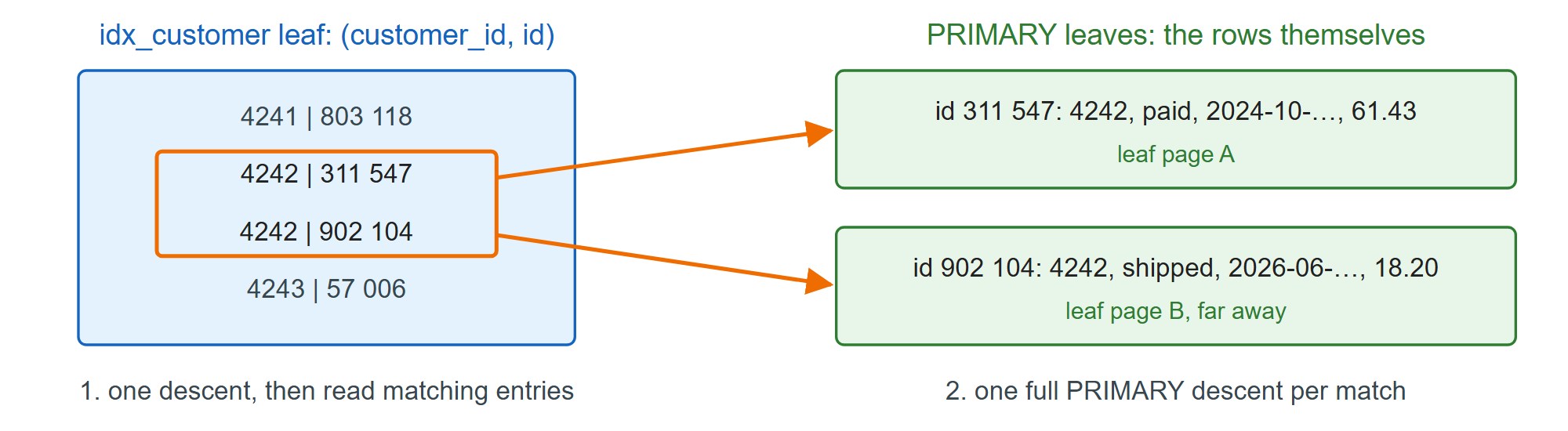
In InnoDB the table is its primary key B+tree, the clustered index. Without a primary key, InnoDB clusters on the first all-NOT NULL UNIQUE index, or on a hidden 6-byte row id (GEN_CLUST_INDEX; Primary Keys). Every other index is secondary: its entries hold the indexed columns plus the primary key, and reaching the row takes a second descent.
CREATE INDEX idx_customer ON big_orders (customer_id);
SELECT COUNT(*), SUM(total) INTO @n, @s FROM big_orders WHERE customer_id = 4242;
SELECT stat_name, stat_value, stat_description FROM mysql.innodb_index_stats
WHERE database_name = 'shop' AND table_name = 'big_orders'
  AND index_name = 'idx_customer' AND stat_name LIKE 'n_diff%';
SELECT COUNT(*), SUM(total) INTO @n, @s FROM big_orders FORCE INDEX (idx_customer)
WHERE customer_id <= 5000;Query OK, 0 rows affected (2.439 sec) Records: 0 Duplicates: 0 Warnings: 0 Query OK, 1 row affected (0.000 sec) +--------------+------------+------------------+ | stat_name | stat_value | stat_description | +--------------+------------+------------------+ | n_diff_pfx01 | 49961 | customer_id | | n_diff_pfx02 | 1000064 | customer_id,id | +--------------+------------+------------------+ 2 rows in set (0.000 sec) Query OK, 1 row affected (0.224 sec)
The customer query fell from 0.17 s to under a millisecond. n_diff_pfx02 counts (customer_id, id) pairs, exposing the hidden column: a CHAR(36) UUID key adds 36 bytes or more to every secondary entry. Many matches mean many descents: forced (Hints), the index took 0.22 s for 100,000 orders, no faster than the optimizer's own scan (Covering Indexes). With two million rows and a cold cache, the same test took 8.4 s against 0.55 s.