A diffusion model learns to undo a simple forward process that blends a training image x0 with Gaussian noise eps over T steps (T = 1000 in Ho, Jain and Abbeel's 2020 DDPM paper). Any step can be reached in one jump: x_t = sqrt(alphaBar_t) * x0 + sqrt(1 - alphaBar_t) * eps, where alphaBar_t (ᾱ) falls from 1 to 0 on a fixed noise schedule. The figure applies it with the cosine schedule to six book spines, drawn with ImageData's ImageData.
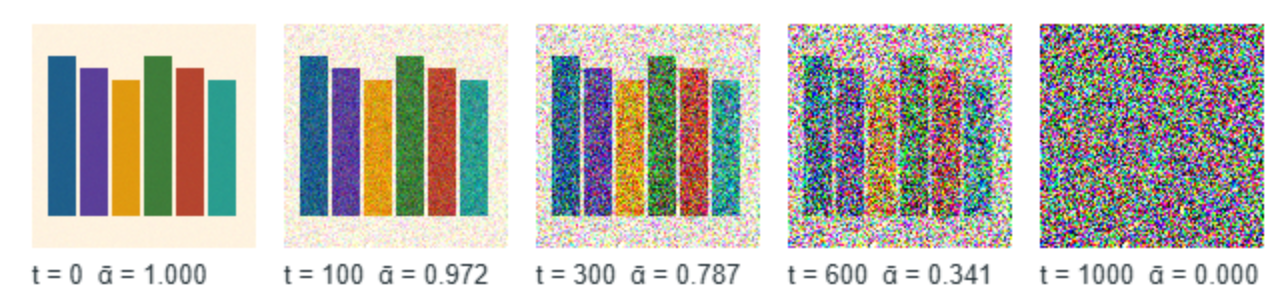
Training asks the network to predict the noise added to an image at step t. Generation runs backward: from pure noise, predict the noise, remove part of it, repeat. Modern samplers (DDIM, DPM-Solver) need 20-50 steps, not 1,000. Early steps fix layout and color and late ones add texture, as Streaming Partial Images's partial images show.
<!doctype html>
<style>
  body { margin: 0; padding: 8px; background: #fafaf7; font: 12px system-ui, sans-serif; color: #263238; }
  canvas { display: block; max-width: 100%; }
  .ui { margin: 6px 0; }
</style>
<canvas id="strip" width="600" height="150"></canvas>
<div class="ui">t = <input type="range" id="t" min="0" max="1000" value="400" style="width:300px"> <b id="tv"></b>
  <button id="reverse">Run the reverse process</button></div>
<canvas id="big" width="600" height="200"></canvas>
<script>
  const S = 110;                                         // each tile is S × S pixels
  // x0: six book spines on a shelf, drawn once into ImageData
  const src = document.createElement('canvas');
  src.width = src.height = S;
  const g = src.getContext('2d');
  g.fillStyle = '#fff3e0';  g.fillRect(0, 0, S, S);
  ['#1f5f8b', '#5b3f99', '#e09a10', '#3f7d3a', '#b5452f', '#2a9d8f'].forEach((c, i) => {
    g.fillStyle = c;  g.fillRect(8 + i * 16, 22 + (i % 3) * 8, 13, 70 - (i % 3) * 8);
  });
  g.fillStyle = '#6b4f3a';  g.fillRect(0, 92, S, 8);
  const x0 = g.getImageData(0, 0, S, S).data;

  // A fixed noise image eps ~ N(0, 1) per channel (Box-Muller with a seeded generator)
  let seed = 7;
  const rand = () => (seed = (seed * 16807) % 2147483647) / 2147483647;
  const eps = Float32Array.from({ length: x0.length }, () => Math.sqrt(-2 * Math.log(rand() || 1e-9)) * Math.cos(2 * Math.PI * rand()));

  // Cosine schedule (Nichol and Dhariwal): alphaBar falls from 1 to 0 as t goes 0 → T
  const T = 1000, alphaBar = t => Math.cos(((t / T + 0.008) / 1.008) * Math.PI / 2) ** 2;

  // Jump straight to step t: x_t = sqrt(ab) * x0 + sqrt(1 - ab) * eps, in [-1, 1] pixel units
  function noisy(t, target, x0data = x0) {
    const ab = alphaBar(t), a = Math.sqrt(ab), b = Math.sqrt(1 - ab);
    const out = new ImageData(S, S);
    for (let i = 0; i < x0data.length; i += 4) {
      for (let c = 0; c < 3; c++) {
        const v = a * (x0data[i + c] / 127.5 - 1) + b * eps[i + c];
        out.data[i + c] = (v + 1) * 127.5;
      }
      out.data[i + 3] = 255;
    }
    return out;
  }

  // The strip: five steps of the forward process
  const strip = document.getElementById('strip').getContext('2d');
  strip.font = '12px system-ui';
  [0, 200, 400, 600, 1000].forEach((t, k) => {
    strip.putImageData(noisy(t), 8 + k * 118, 8);
    strip.fillStyle = '#263238';
    strip.fillText(`t = ${t}, ᾱ = ${alphaBar(t).toFixed(2)}`, 8 + k * 118, 136);
  });

  // The big view: pick any t, or watch a (cheating) reverse process that walks t back to 0
  const big = document.getElementById('big').getContext('2d');
  const tile = document.createElement('canvas');
  tile.width = tile.height = S;
  function show(t) {
    tile.getContext('2d').putImageData(noisy(t), 0, 0);
    big.imageSmoothingEnabled = false;
    big.clearRect(0, 0, 600, 200);
    big.drawImage(tile, 0, 0, 180, 180);
    big.fillStyle = '#263238';  big.font = '13px system-ui';
    const ab = alphaBar(t);
    big.fillText(`signal weight sqrt(ᾱ) = ${Math.sqrt(ab).toFixed(3)}`, 200, 30);
    big.fillText(`noise weight sqrt(1 − ᾱ) = ${Math.sqrt(1 - ab).toFixed(3)}`, 200, 52);
    // the schedule curve with the current step marked
    big.strokeStyle = '#1f5f8b';  big.beginPath();
    for (let s = 0; s <= T; s += 10) big.lineTo(200 + s * 0.38, 180 - alphaBar(s) * 100);
    big.stroke();
    big.fillStyle = '#e09a10';  big.beginPath();  big.arc(200 + t * 0.38, 180 - ab * 100, 5, 0, 7);  big.fill();
    big.fillStyle = '#263238';  big.fillText('ᾱ(t), cosine schedule', 420, 90);
    document.getElementById('tv').textContent = t;
  }
  const slider = document.getElementById('t');
  slider.addEventListener('input', () => show(+slider.value));
  document.getElementById('reverse').onclick = () => {
    // A trained network would predict eps at each step; here we know it, so 25 sampler steps suffice
    let t = T;
    const timer = setInterval(() => {
      t = Math.max(0, t - 40);
      slider.value = t;  show(t);
      if (t === 0) clearInterval(timer);
    }, 80);
  };
  show(400);
</script>