A loading.js gives a route one boundary. <Suspense> gives it as many as you want, each resolving on its own. The demo's dashboard reads two numbers, one after 400 ms and one after 2 s, in separate boundaries:
export default function Dashboard() {
  return <div>
    <h1>Dashboard</h1>
    <Suspense fallback={<p>Loading revenue...</p>}><Revenue /></Suspense>
    <Suspense fallback={<p>Loading orders...</p>}><Orders /></Suspense>
  </div>
}
Printing every chunk as it arrives — with Accept-Encoding: identity, since a compressor buffers — shows the server answering five times across two seconds instead of once at the end:
--- chunk 0 (+1ms, 5075 bytes)   shell: <h1> and both fallbacks
    <template id="B:0"></template><p>Loading revenue...</p>
    <template id="B:1"></template><p>Loading orders...</p>
--- chunk 1 (+396ms, 127 bytes)  payload for the revenue paragraph
--- chunk 2 (+396ms, 933 bytes)
    <div hidden id="S:0"><p id="revenue">Revenue: 412,900</p></div>
    <script>$RC("B:0","S:0")</script>
--- chunk 3 (+1995ms, 124 bytes) payload for the orders paragraph
--- chunk 4 (+1997ms, 119 bytes) <div hidden id="S:1">... $RC("B:1","S:1")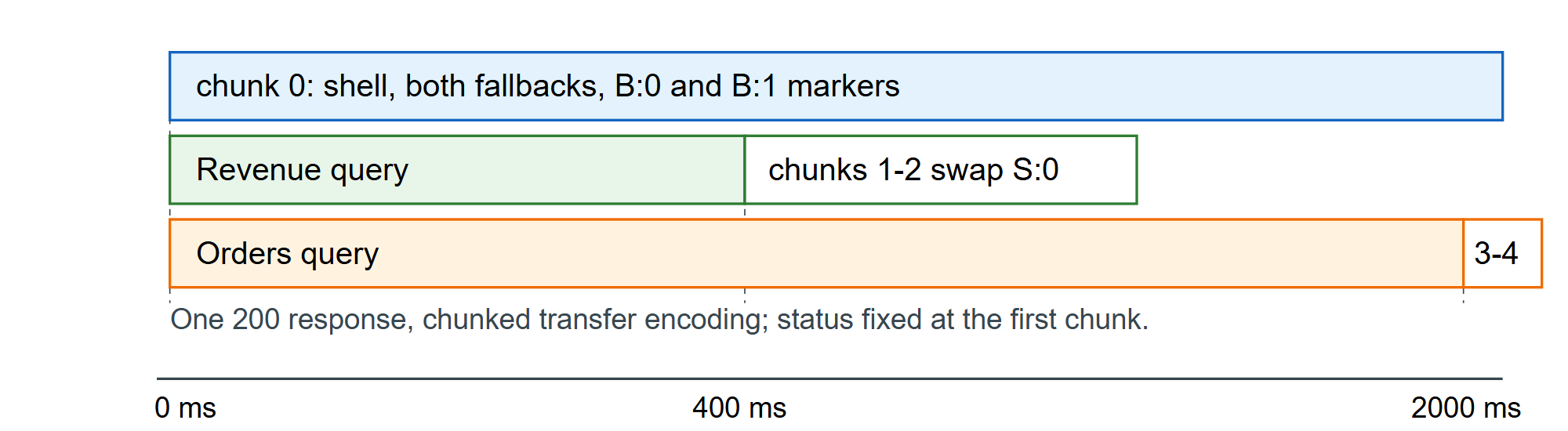
Where the boundaries sit decides what the visitor sees. Everything above them is the static shell, sent in chunk 0; everything inside is a hole filled later. So push the dynamic read down to the component that needs it instead of awaiting at the top of a page, and pass the unresolved promise along: <Suspense fallback={...}><ProductGrid paramsPromise={params} /></Suspense> keeps the rest of the page in the shell while only the grid waits.
Two consequences are easy to miss. Because the status line goes out with chunk 0, a notFound() or redirect() firing later cannot change it — Next.js 10,514 returns 200 and injects <meta name="robots" content="noindex">, or redirects on the client. And anything that buffers between your server and the browser destroys the effect: nginx 75 buffers by default (send X-Accel-Buffering: no), some CDNs and serverless runtimes buffer, and Safari 10 holds a response until 1024 bytes arrive. Keep the Largest Contentful Paint element outside every boundary.