A columnar store writes all values of one column contiguously, usually in chunks of many thousands of rows so that a file still splits into independent pieces (Parquet 129 's row groups, Row Groups and Pages).
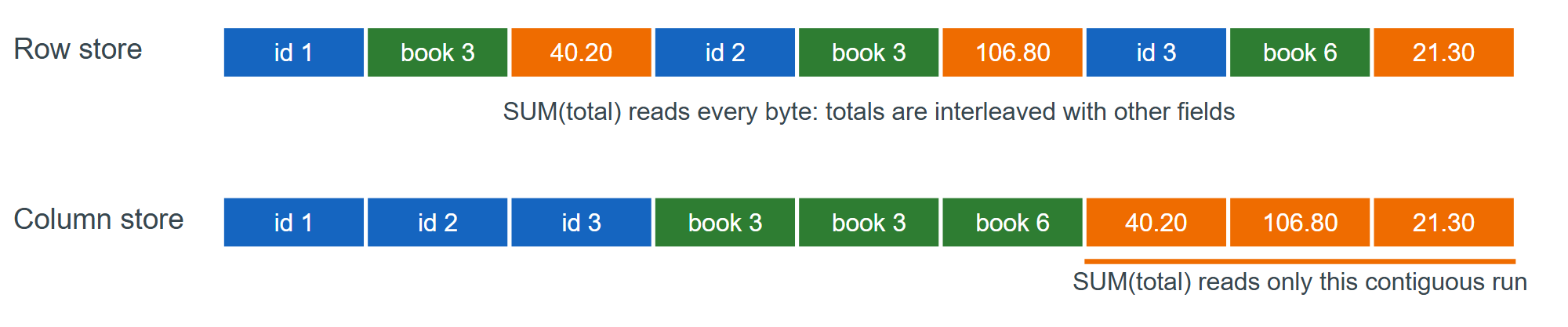
Values of one type sit together, so dictionary and run-length encodings (Parquet Encodings) and general compressors work better. Even plain zlib shows it on six order columns written both ways:
import csv, zlib
cols = ["order_id", "customer_id", "order_ts", "channel", "status", "total"]
with open("csv-out/orders.csv", newline="", encoding="utf-8") as f:
    rows = [[r[c] for c in cols] for r in csv.DictReader(f)]
row_major = "\n".join(",".join(r) for r in rows).encode()
col_major = "\n".join(",".join(r[i] for r in rows) for i in range(len(cols))).encode()
for name, blob in (("row-major", row_major), ("column-major", col_major)):
    packed = len(zlib.compress(blob, 6))
    print(f"{name:12} {len(blob):>10,} bytes -> zlib {packed:>9,} ({len(blob) / packed:.1f}x)")
Output
row-major     5,249,279 bytes -> zlib 1,179,871 (4.4x)
column-major  5,249,279 bytes -> zlib   983,846 (5.3x)
Same bytes, different order: the column-major version compresses 17 percent smaller. The price is paid on writes, since one new order touches every column, so columnar files are written in large, effectively immutable batches.