Warehouses, lakes and lakehouses all assume one central data team that ingests everything. In a large company that team becomes a bottleneck, handling data it does not understand from domains it does not belong to. Zhamak Dehghani, then at Thoughtworks, proposed the alternative in "How to Move Beyond a Monolithic Data Lake to a Distributed Data Mesh" (20 May 2019) and refined it in "Data Mesh Principles and Logical Architecture" (3 December 2020), both on martinfowler.com. Data mesh rests on four principles:
Domain-oriented decentralized data ownership and architecture: the orders team owns the orders data.
Data as a product: datasets are published with documentation, quality guarantees and a named owner.
Self-serve data infrastructure as a platform: a platform team provides storage, pipelines and catalog.
Federated computational governance: shared rules are agreed together and enforced automatically.
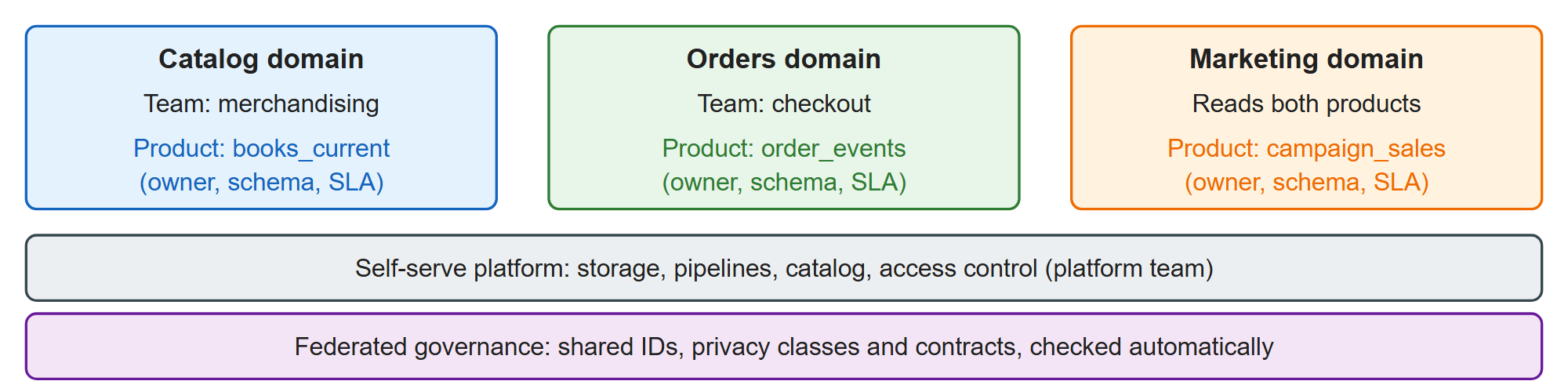
Data mesh is an organizational design more than a technology, and it costs a lot of coordination. It suits companies with many domains and data teams, where the central bottleneck is real. A small company like BookNest, with one data engineer, gains nothing from splitting ownership; it should borrow the parts that scale down: named owners, documented datasets, and data contracts between producers and consumers (Anomalies, Contracts, Lineage).