An AWS 24 Region is a geographic area with its own copy of most services, named by a code such as us-east-1 (Northern Virginia). AWS lists 39 Regions; the 17 launched before 20 March 2019 are enabled by default, and newer ones such as Malaysia (ap-southeast-5) need an opt-in first. Each Region has at least three Availability Zones (AZs) of one or more data centers with separate power and networking. A server lives in one AZ, so spreading servers over two AZs survives an outage.
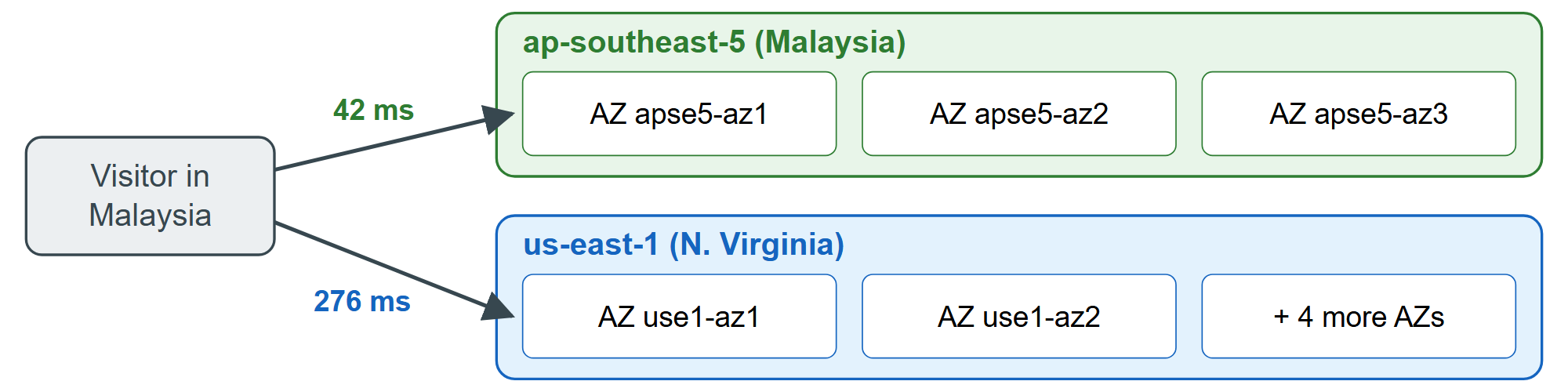
Latency is paid on every round trip, so measure it from where your users are. This loop times the TCP handshake to each Region's public API endpoint, which needs no account:
for r in ap-southeast-5 ap-southeast-1 eu-west-1 us-east-1; do
  for n in 1 2 3 4 5; do   # best of five handshakes, DNS time excluded
    curl -s -o /dev/null -w '%{time_namelookup} %{time_connect}\n' "https://ec2.$r.amazonaws.com/"
  done | awk -v r="$r" '{ms = ($2 - $1) * 1000; if (NR == 1 || ms < best) best = ms}
    END {printf "%-15s %4.0f ms\n", r, best}'
doneap-southeast-5 42 ms ap-southeast-1 50 ms eu-west-1 215 ms us-east-1 276 ms
Choose the nearest Region that has the services you need; prices also differ by Region. This chapter uses us-east-1, the oldest and largest. Most resources, key pairs included, exist in one Region only, and in old accounts an AZ name such as us-east-1a can map to a different building per account; the AZ ID (use1-az1) never does.