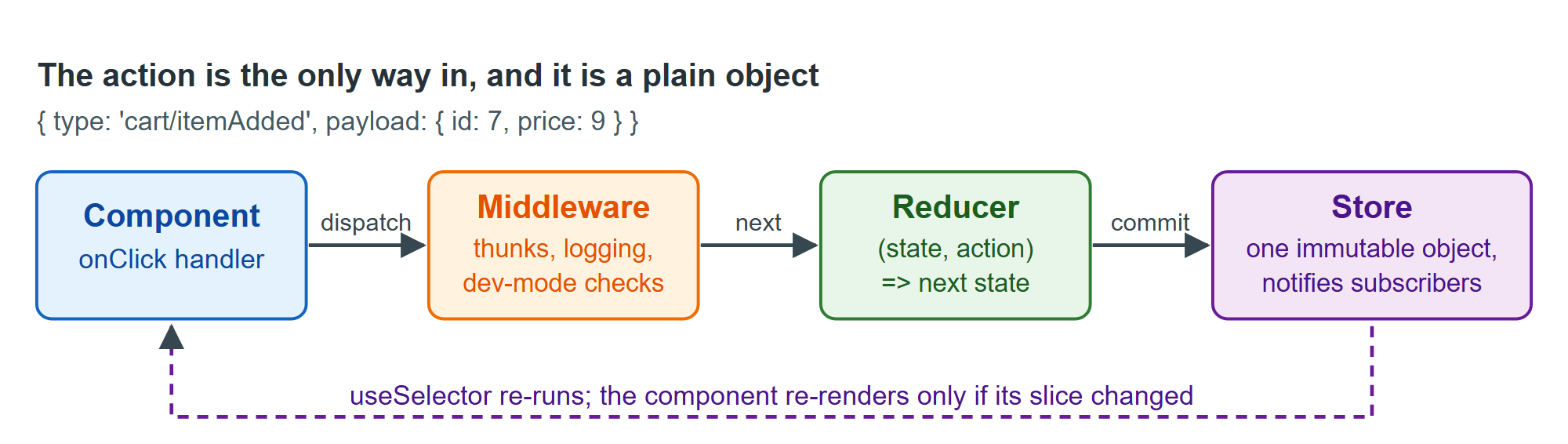
Redux 3,824 is a single JavaScript object holding the state several parts of your application care about, plus one rule for changing it: you never assign to that object. You dispatch a plain action describing what happened, and a pure reducer returns the next object. Every change therefore has a name, an order and a payload, which is why a Redux application can be replayed, logged, time-travelled and tested without a browser.
That discipline costs boilerplate, and Redux Toolkit 3,824 removes almost all of it. The official package (@reduxjs/toolkit 2.12.0, released 15 May 2026) wraps Redux 5.0.1, Immer 11 28,983 , Reselect 5 19,013 and redux-thunk 3, and is how the Redux team recommends writing Redux today. createStore, applyMiddleware and connect() still work, and you meet them here only so you can read older code.
npm install @reduxjs/toolkit react-reduxreact-redux 9.3.0 is the binding layer between the store and your components; you never install redux yourself. It needs React 18 7,897 or 19, because it is built on useSyncExternalStore (useSyncExternalStore).
Subsections
- When to Use a Store
- Store, Actions and Reducers
- Combining Reducers
- Middleware
- Thunks
- Redux DevTools
- The Provider
- useSelector and useDispatch
- useStore
- connect as Legacy
- configureStore
- createSlice
- createAsyncThunk
- createEntityAdapter
- createSelector
- Listener Middleware
- Queries with RTK Query
- Mutations with RTK Query
- Cache Lifetime and Refetching