GX has no Iceberg 129 connector, so the script reads the table through DuckDB 61,228 into pandas 16,086 (at scale, pass a Spark 129 DataFrame from lake.py). The suite includes a freshness rule: the latest order must be from this week.
"""GX Core 1.23: an expectation suite for the Iceberg orders table, run by a checkpoint."""
import great_expectations as gx
import great_expectations.expectations as gxe
from lakeduck import connect
orders = connect().sql("SELECT * FROM orders").df()                # 100,000 rows, via DuckDB
context = gx.get_context(mode="file", project_root_dir="gx")       # suites, results, Data Docs
batch = (context.data_sources.add_or_update_pandas("lakehouse")
         .add_dataframe_asset("orders").add_batch_definition_whole_dataframe("all"))
suite = context.suites.add_or_update(gx.ExpectationSuite(name="orders_suite", expectations=[
    gxe.ExpectTableRowCountToBeBetween(min_value=90_000, max_value=200_000),
    gxe.ExpectColumnValuesToBeUnique(column="order_id"),
    gxe.ExpectColumnValuesToBeInSet(column="status", value_set=[
        "pending", "paid", "shipped", "delivered", "returned", "cancelled"]),
    gxe.ExpectColumnValuesToBeBetween(column="discount", min_value=0, max_value=20,
                                      mostly=0.999),          # 99.9% of rows is enough
    gxe.ExpectColumnMaxToBeBetween(column="order_ts", min_value="2026-10-01T00:00:00+00:00"),
]))
checkpoint = context.checkpoints.add_or_update(gx.Checkpoint(
    name="orders_checkpoint", actions=[gx.checkpoint.UpdateDataDocsAction(name="docs")],
    validation_definitions=[context.validation_definitions.add_or_update(
        gx.ValidationDefinition(name="orders_daily", data=batch, suite=suite))]))
result = list(checkpoint.run(batch_parameters={"dataframe": orders}).run_results.values())[0]
for r in result.results:
    cfg, res = r.expectation_config, r.result
    seen = (f"observed {res['observed_value']}" if "observed_value" in res
            else f"unexpected {res['unexpected_count']}")
    column = cfg.kwargs.get("column", "")
    print(f"{'PASS' if r.success else 'FAIL'} {cfg.type:<36} {column:<11} {seen}")
print("suite success:", result.success)
Output
PASS expect_table_row_count_to_be_between             observed 100000
PASS expect_column_values_to_be_unique    order_id    unexpected 0
PASS expect_column_values_to_be_in_set    status      unexpected 0
PASS expect_column_values_to_be_between   discount    unexpected 13
FAIL expect_column_max_to_be_between      order_ts    observed 2026-06-30 23:55:02+00:00
suite success: False
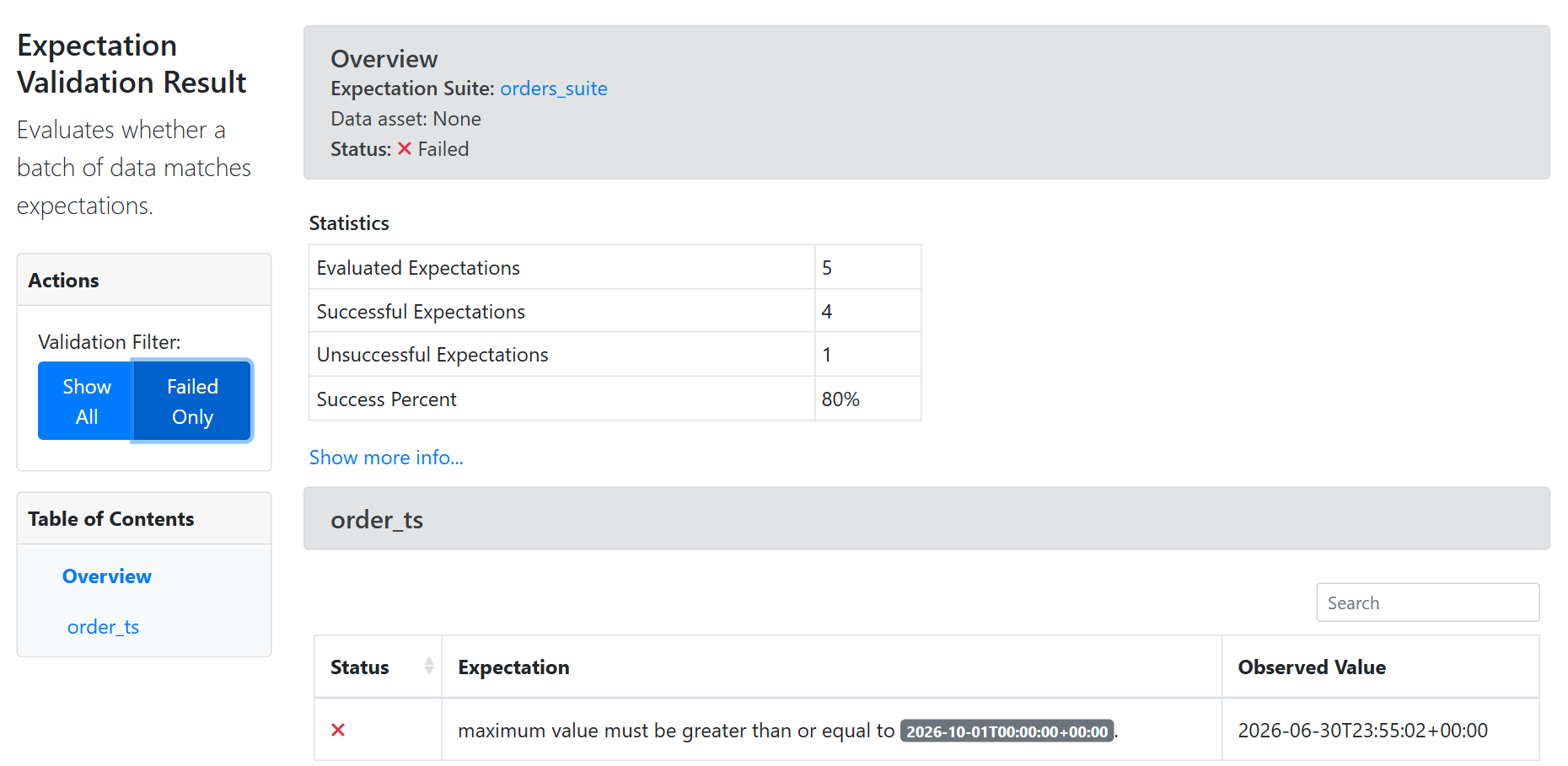
Thirteen discounts above 20 stay within the 0.1% tolerance. The freshness check fails: the history ends on 30 June, the silent staleness a dashboard never shows. The checkpoint rebuilt Data Docs, here filtered to failures:
Keep the suites (JSON under gx/) in Git 1,932 , and let the orchestrator fail the run when result.success is false.