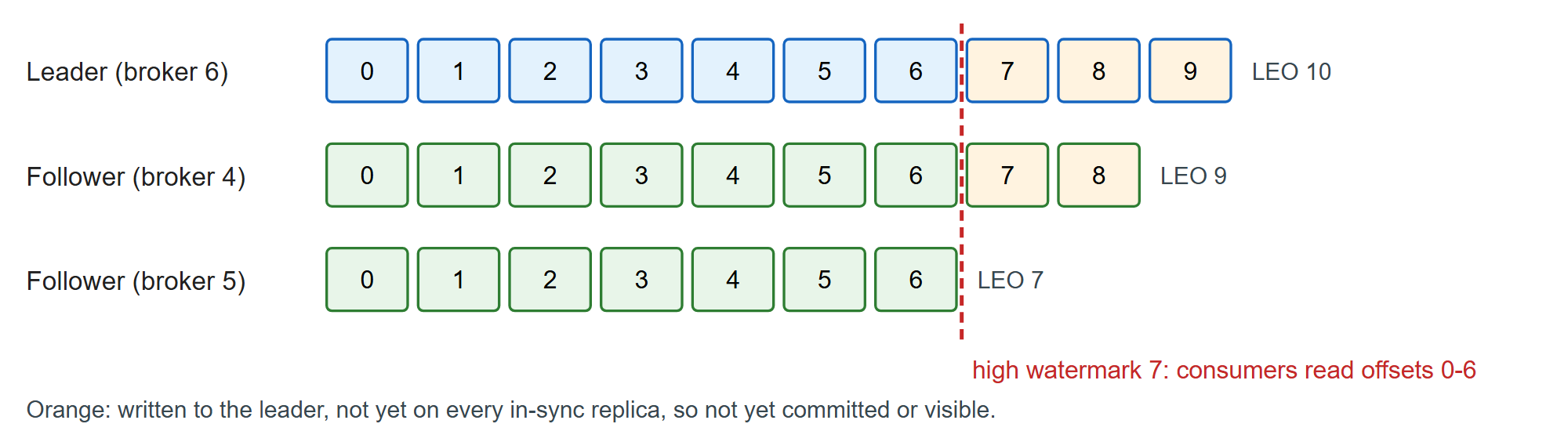
Each replica has its own log end offset (LEO). The lowest LEO among the ISR is the high watermark (HW): records below it are on every in-sync replica, so they are committed, and only they are visible to consumers.
The HW alone could not stop a returning replica from truncating too much, or a former leader from keeping records no one else has. KIP-101 added the leader epoch, raised at every leader change and stamped on each batch; each replica's leader-epoch-checkpoint maps epochs to first offsets, so a returning replica asks the leader where its last epoch ended and truncates exactly there.
# Partition 0's leader epoch cache and high watermark on each broker, and its batches' epochs
D=/var/lib/kafka/data
for b in 4 5 6; do
  epochs=$(docker exec l3-b$b tail -n +3 $D/booknest.ops-check-0/leader-epoch-checkpoint)
  hw=$(docker exec l3-b$b grep 'booknest.ops-check 0 ' $D/replication-offset-checkpoint)
  echo "broker $b: epoch/start offset: $(echo $epochs | xargs)  high watermark: ${hw##* }"
done
docker exec l3-b4 /opt/kafka/bin/kafka-dump-log.sh \
  --files $D/booknest.ops-check-0/00000000000000000000.log |
  awk '/baseOffset/ {print "offset", $2, "written in leader epoch", $16}'
Output
broker 4: epoch/start offset: 0 0 1 1  high watermark: 2
broker 5: epoch/start offset: 0 0 1 1  high watermark: 2
broker 6: epoch/start offset: 0 0 1 1  high watermark: 2
offset 0 written in leader epoch 0
offset 1 written in leader epoch 1
The first write went into epoch 0 under broker 4, the second into epoch 1 under broker 5, and the refused third left nothing; all replicas agree.