AI assistants answer current questions with retrieval-augmented generation (RAG), which Google says is "also known as grounding": the model searches an index, reads the retrieved pages and writes an answer with links to the pages that support it. Google grounds AI Overviews and AI Mode in its core ranking systems and query fan-out (AI Overviews). ChatGPT search surfaces sites through OAI-SearchBot, Perplexity through PerplexityBot, and Claude 2,500 through Claude-SearchBot and Claude-User (llms.txt and AI Crawlers).
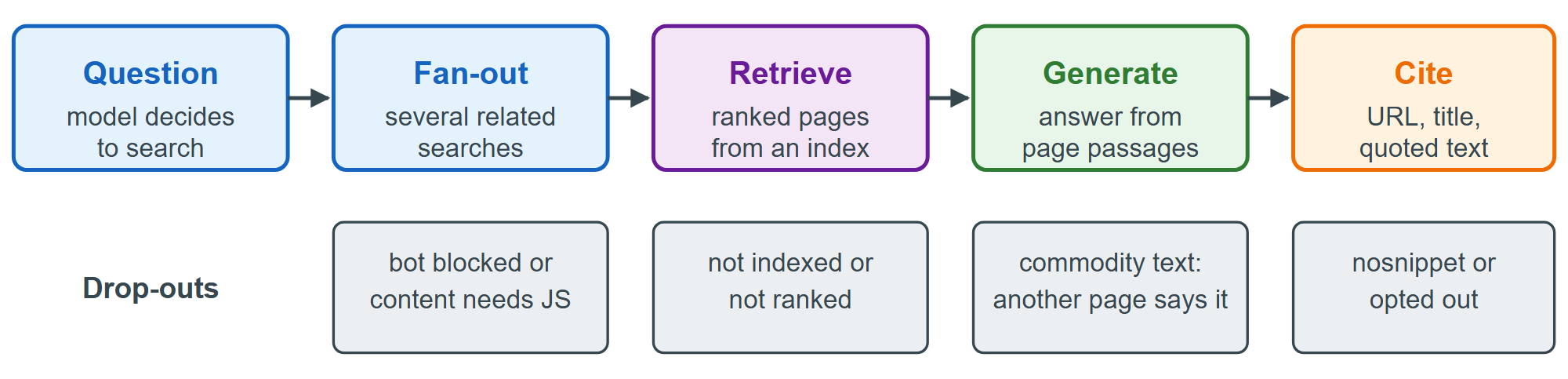
In Anthropic's web search API, for example, the model decides when to search, may search several times, and attaches citations to parts of its answer, each with a URL, a title and up to 150 characters of cited_text. A citation points at a passage, so facts you want credited must be text in your initial HTML (Rendering Modes and SEO).
What the evidence says. The 2023 paper GEO: Generative Engine Optimization (Aggarwal et al., KDD 2024) tested page rewrites on its GEO-bench query set: adding citations, quotations and statistics raised visibility by 30-40% on its main metric, while keyword stuffing did not help. For its own AI features, Google says to skip chunking content, rewriting for AI, buying mentions and special schema.org markup, and to write "non-commodity content": first-hand experience and data that summaries cannot supply.