A website you build in your editor becomes public only when a machine that is always on, always connected and reachable by a domain name serves its files. You can run that machine yourself (Choosing Your Server and Setting Up Your Server), or rent part of someone else's. Hosting services sell that part at different levels of the software stack, and the level you choose decides how much you control and how much you must maintain.
Cloud providers describe the levels with three service models. With Infrastructure as a Service (IaaS) you rent virtual machines and manage everything from the operating system up. With Platform as a Service (PaaS) you push code and the provider runs it on a managed runtime. With Software as a Service (SaaS) you use a finished application, such as a hosted website builder, and manage only your content and settings.
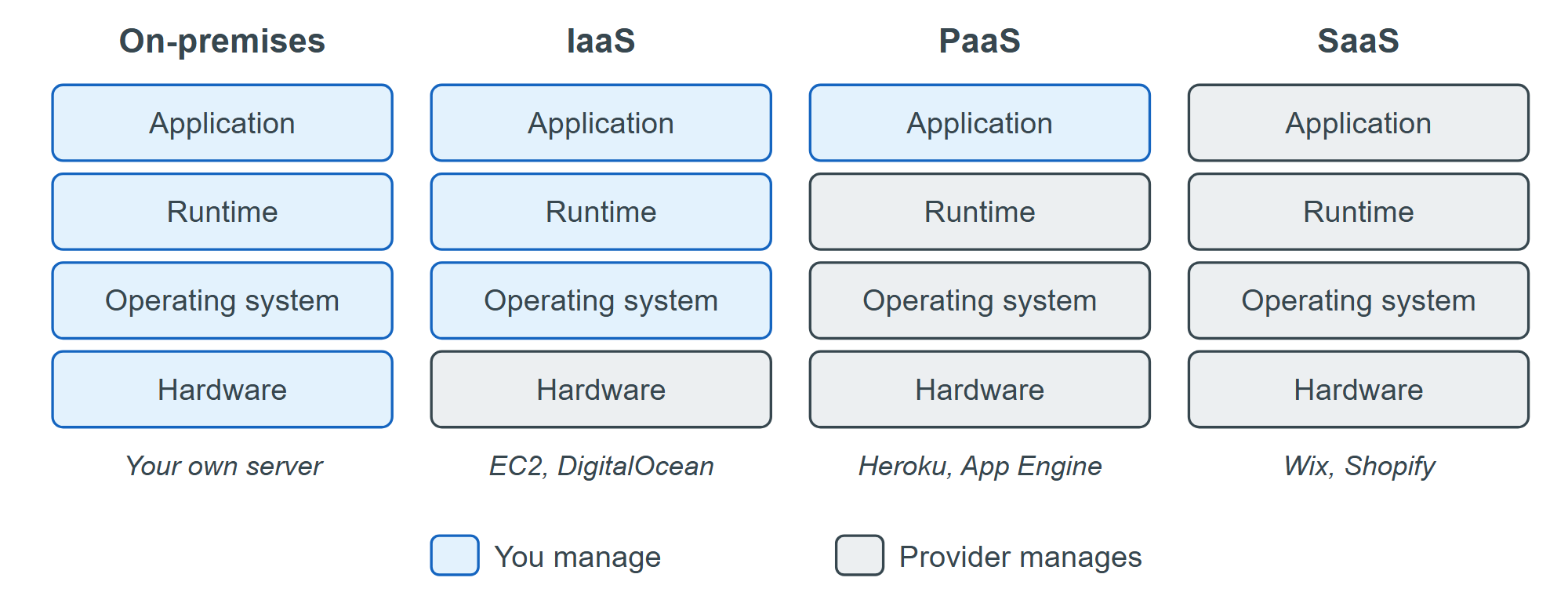
The boundaries blur in practice. Containers sit between IaaS and PaaS: Docker 514 , released in 2013, packages an application with its libraries and configuration into an image that runs on a shared operating-system kernel, so one image runs the same on your laptop, a VPS or a managed container service. Docker is now the most used tool in the Stack Overflow Developer Survey 2025's cloud category (71.1% of respondents), ahead of AWS 24 (43.3%). The subsections that follow move from the most managed option, a content management system, through rented servers to static hosting on a content delivery network.