BookNest's interface is 80 lines of hand-written HTML and CSS. A real app needs tab bars, pull-to-refresh, modal sheets and date pickers that look at home on both platforms, and Cordova 129 supplies none of them; it also leaves you to build locally and to draw every pixel in a WebView. The tools that fill those gaps fall into four groups:
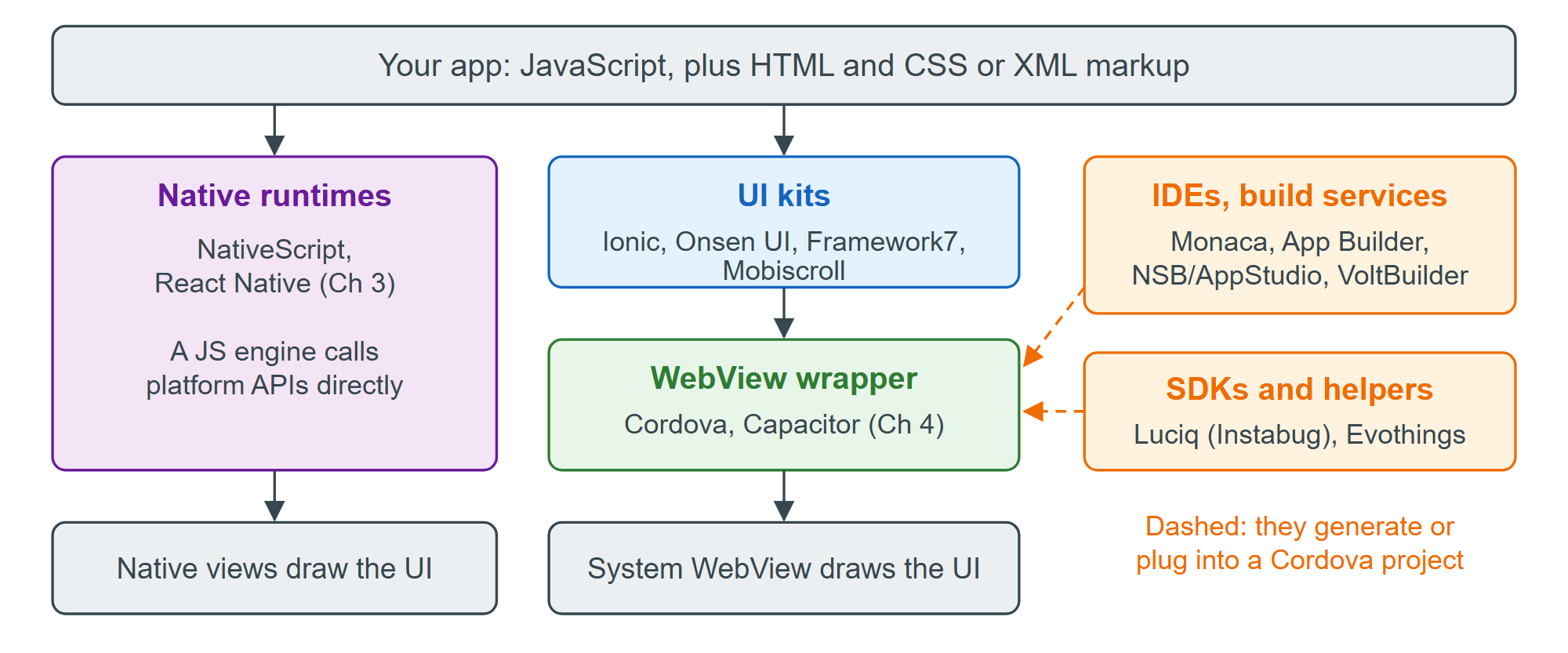
UI kits make the WebView look native and still need a wrapper; native runtimes drop the WebView; IDEs and build services generate or compile Cordova projects for you; SDKs are plugins with a vendor behind them.
| Tool | Group | License or price | State, September 2026 |
|---|---|---|---|
| Ionic 9.0.5 20,753 | UI kit | MIT, free | Active, 52,685 stars |
| Onsen UI 2.12.9 450,074 | UI kit | Apache 2.0, free | Last push June 2026 |
| Framework7 9.1.3 572,986 | UI kit | MIT, free | Active (Framework7) |
| NativeScript 9.1 280,332 | Native runtime | Open source, free | Active, OpenJS Foundation |
| Monaca | IDE, cloud builds | Free tier; $22-$1,100/month | Active |
| DecSoft App Builder 2026.27 | Visual IDE | €260 one-time | Active |
| NSB/AppStudio 9 | IDE, BASIC or JS | One-time or subscription | Active |
| Mobiscroll 6 | UI components | Lite free; Pro from $995 | Active |
| Luciq 13,353 (Instabug) | Bug reporting SDK | Commercial | Cordova plugin fading |
| Evothings Studio 54 | IoT live reload | Apache 2.0 | Dead since 2020 |
Open-source kits can outlive their sponsors because anyone can fork them. Commercial tools save time, but check their export first: a tool that hands you a plain Cordova project is one you can leave.