Tim Berners-Lee's 1991 "HTML Tags" note described 18 elements. The language then passed through the IETF and the W3C, which froze numbered versions and bet the future on XML-based XHTML. In 2004 Apple, Mozilla and Opera 89 , unhappy with that direction, founded the WHATWG to extend HTML for web applications; its work became known as "HTML5". For years two competing specifications existed, until the W3C and WHATWG agreed on May 28, 2019 to maintain a single one.
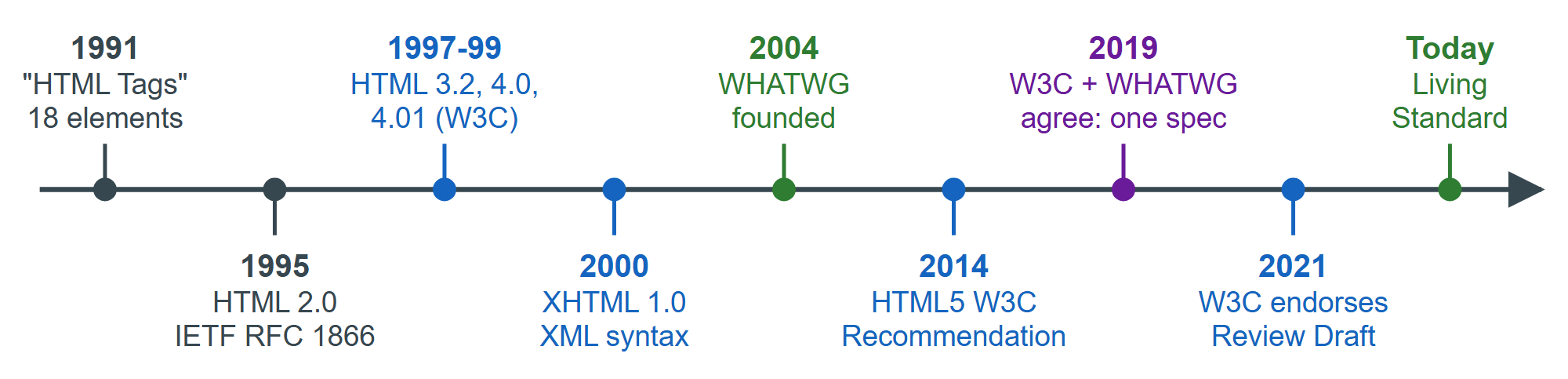
Today's HTML Living Standard (https://html.spec.whatwg.org/ 11,120 ) has no version number. Editors merge changes as pull requests on GitHub 29 , and a new feature needs support from at least two browser implementers plus matching tests in the shared web-platform-tests suite. Roughly every six months the WHATWG snapshots a Review Draft for patent review; the W3C endorsed the January 2020 draft as a Recommendation on January 28, 2021. "HTML5" survives only as a buzzword: no browser checks a version, and <!doctype html> means "the current standard".
A feature in the standard is not automatically usable, so check support with Baseline, a status that the W3C WebDX Community Group computes for each feature over the core browser set: Chrome 1 and Edge, Firefox 555 , and Safari 10 , on desktop and mobile. Newly available means every core browser ships it; widely available follows 30 months later; everything else is limited availability. MDN 102 pages and caniuse.com 3,038 show the badge.
| HTML feature | Baseline status (September 2026) | Since |
|---|---|---|
| <dialog> | Widely available | March 2022 (newly) |
| <search> | Widely available | April 2026 |
| popover attribute | Newly available | January 2025 |
| command / commandfor | Newly available | December 2025 |
| Customizable <select> | Limited (Chromium 4,389 only) | Chrome 135 |
The data lives in the open-source web-features (https://github.com/web-platform-dx/web-features 939 ) package (npm 2,036 install web-features), which build tools consume. Browserslist, which drives Autoprefixer 22,226 and Babel 41,624 , accepts the query baseline widely available, so your whole toolchain can target the same definition.
Practical rule: use widely available features freely, use newly available ones with a fallback or a quick check of your analytics, and treat limited features as progressive enhancements that the page must work without.