The lang attribute (and hreflang on links, srclang on <track>) takes a BCP 47 language tag: a primary language, usually a two-letter ISO 639-1 code, then optional hyphen-separated subtags for script (ISO 15924, Hant) and region (ISO 3166-1 or a UN number, TW, 419). Tags are case-insensitive but conventionally written zh-Hant-TW, and every valid subtag is listed in the IANA Language Subtag Registry. Use the shortest correct tag: fr unless the regional variant really differs.
| Language | Tag | Language | Tag | Language | Tag |
|---|---|---|---|---|---|
| English (US, UK) | en-US en-GB | Arabic, Persian | ar fa | Chinese (Simplified) | zh-Hans |
| Spanish (Latin Am.) | es es-419 | Hebrew | he (not iw) | Chinese (Traditional) | zh-Hant |
| Portuguese (Brazil) | pt pt-BR | Hindi, Bengali | hi bn | Japanese, Korean | ja ko |
| French (Canada) | fr fr-CA | Urdu, Turkish | ur tr | Vietnamese, Thai | vi th |
| German, Italian | de it | Russian, Ukrainian | ru uk | Indonesian | id (not in) |
| Dutch, Polish | nl pl | Swahili | sw | Malay, Filipino | ms fil |
Screen readers pick a voice from the tag and browsers use it for hyphenation, spell checking and :lang(). For Chinese, Japanese and Korean it also selects glyphs, because Unicode unifies Han characters each locale draws differently:
<div style="font: 32px sans-serif">
  <div lang="ja">骨 次 册 写 真 (ja)</div>
  <div lang="zh-Hans">骨 次 册 写 真 (zh-Hans)</div>
  <div lang="ko">骨 次 册 写 真 (ko)</div>
</div>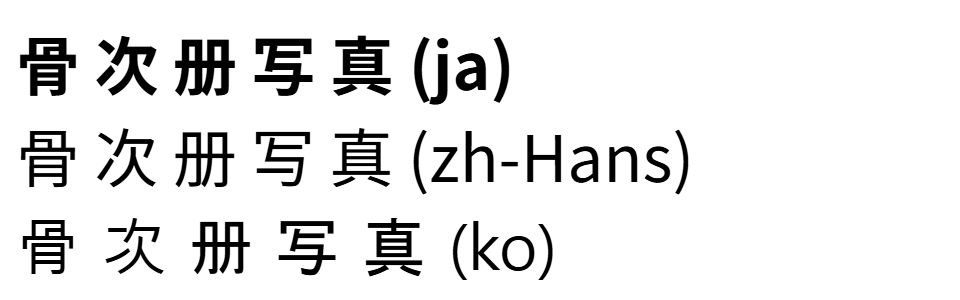
On multilingual sites, add <link rel="alternate" hreflang="fr-CA" href="..."> for every translation. Google requires a language before any region (en-GB, never GB), reserves x-default for the fallback page, and detects a page's language from its text, not from lang.